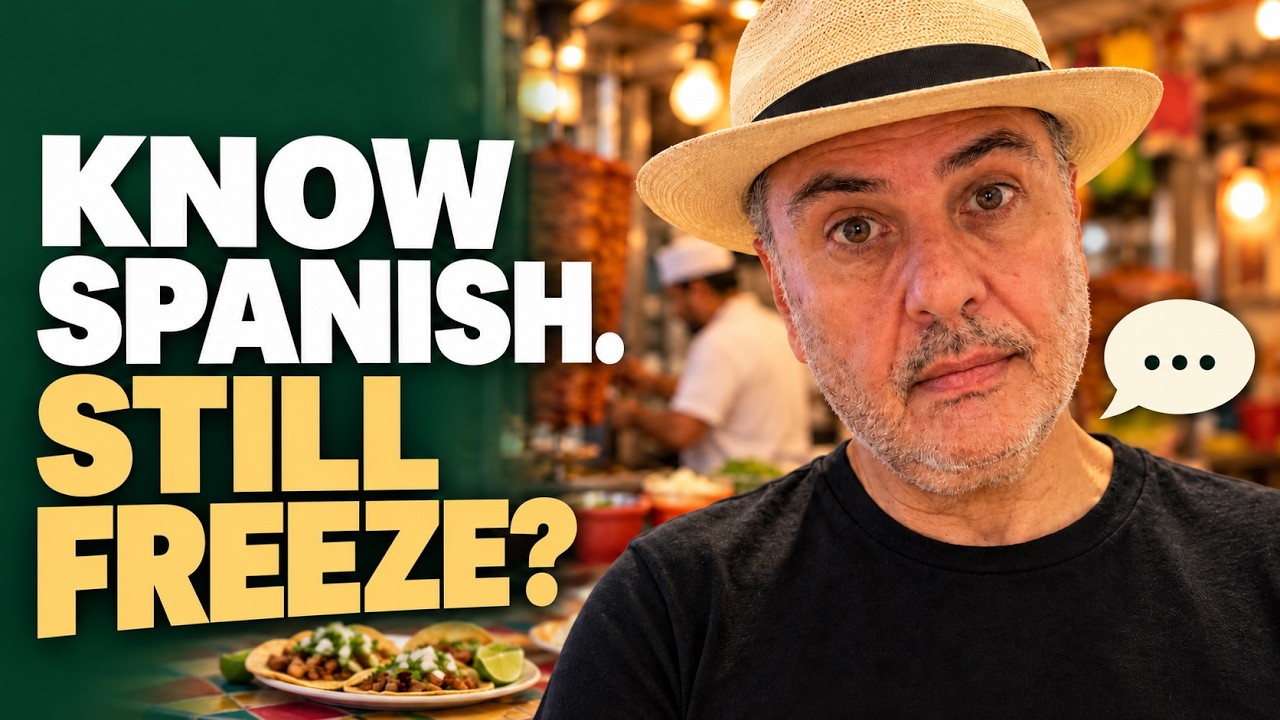
How do you speak Spanish without freezing? Speaking is its own skill, and you train it by speaking. Don’t build sentences on day one: borrow them, as whole phrases (chunks). Learn the situation, not the word list. Rehearse tomorrow’s conversation out loud before it’s real. And keep one rescue line ready: “Estoy aprendiendo español.” (I’m learning Spanish.)
That was me a year ago. At the taqueria, I’d point. Grunt. Stare into space. Hope they’d figure it out. Now, at the same taqueria, I order exactly what I want, and I actually talk with the people who work there. A real conversation.
Nothing magic changed. I just stopped following the old rules. In the video above, The New Rules of Learning to Speak Spanish, and on this page, I’ll show you why the way most of us were taught sets us up for exactly that freeze, and then the five new rules that got me talking. You’ll get a method you can use tonight, real phrases, and a line that gets you out of any freeze. No download needed.
This is for you if you live in Mexico and your life is moving faster than your Spanish. If you’ve got a trip coming up. If you studied for years and still freeze. If you want to talk with your partner’s family in their language.
One thing first: this is about speaking. Out loud, to real people. If you want to read Spanish, or pass a test, or you’re happy just understanding, that’s completely fine, but this isn’t for you. If you want to open your mouth and have Spanish come out, keep reading.
Why the old rules don’t get you speaking
Let’s start with the rules we all followed. None of them are stupid. Every one of them works, for something.
- Old rule one: show up every day. A daily habit is great. But a daily habit in an app measures that you opened an app. You can keep it going for two years without ever saying a sentence out loud to a human being. Tapping the right answer is recognition: you see four options and pick the one that looks right. That’s a real skill. It’s just not the one you need when someone’s waiting for you to answer.
- Old rule two: learn the grammar first. Building a sentence from rules is slow. In your head it goes: “I want to ask how she is… ‘to be’ is estar… it’s ‘you’, informal… so estás…” By the time you’ve built it, the server’s moved on to the next table. Grammar is how you understand why a sentence works. It’s not how you produce one in two seconds.
- Old rule three: immerse yourself. Listening matters. You can’t answer what you don’t understand. But I know people who’ve lived in Mexico for years, who understand almost everything, and still freeze when it’s their turn to talk. Understanding fills the tank. It doesn’t teach you to drive.
- Old rule four: speak when you’re ready. When you know enough. When you won’t embarrass yourself. That day doesn’t come. There’s always another tense, another word you don’t know. “Ready” is a moving target.
What you understand vs. what you can say
Daily app habits, grammar and listening all grow one bar: what you understand. And that bar gets tall. That’s why you can follow conversations and read menus.
But the freeze lives in the other bar: what you can actually say, out loud, on the spot. None of the old rules train it. You can’t get better at speaking without speaking, the same way you can’t get better at swimming by reading about water.
You know more Spanish than you can speak.
The 5 new rules of learning to speak Spanish
New rule 1: Speaking is its own skill (watch at 4:25)
You train it by speaking. Not by reading about it. Not by tapping. By opening your mouth and saying the words out loud, over and over, until your mouth knows them before your brain gets involved.
Think about how you answer “How are you?” in English. You don’t think. “Good, you?” It’s automatic. That’s the goal in Spanish too: not perfect, automatic. When a Mexican speaks, answer without thinking.
New rule 2: Speak from day one (borrow chunks) (watch at 4:52)
“How? I can’t speak. That’s the whole problem. I don’t know enough.” Here’s the trick: on day one, you don’t build sentences. You borrow them.
¿Cómo estás? That’s a conjugated verb: second person, informal, present tense of estar. Did anyone ever need to teach you that to say it? No. You just say it, as one piece.
That’s a chunk: a whole phrase that real people say, that you learn as one unit, like a word. You don’t assemble it. You grab it.
Native speakers do this too. Most of what you say in a day isn’t built from scratch. It’s chunks. That’s why native speech is fast: they’re not building, they’re grabbing.
And here’s the bonus: the grammar comes along for free. After you’ve said “¿Cómo estás?” a hundred times, “estás” just sounds right. The rules can come later, once you already sound right. (More on that in why learning with phrases works.)
New rule 3: Learn the situation, not the word list (watch at 6:04)
Okay, but which chunks? There are thousands. This is where most phrasebooks go wrong: they give you 500 phrases in alphabetical order, or by topic, like “colors” and “animals”.
Situation. Chunk. Response. Ask three questions:
- Where will I be?
- What will I need to say?
- And, the one everyone forgets: what will they say back to me?
Let’s do one, right now. The one that used to beat me: the taqueria. You need to order. And at a sit-down taqueria, they’ll almost always ask you one question. When you’re done, you ask for the check.
That’s it. Five phrases and one question you can see coming. That’s a complete meal at a taqueria, from ordering to paying, and nobody had to learn the subjunctive. Say them out loud now. For more, see the taco stand phrases and restaurant phrases.
New rule 4: Rehearse before it’s real (watch at 7:22)
Actors don’t walk on stage and improvise Shakespeare. Pilots don’t learn to land in a real storm. They rehearse in a safe place, so that when it’s real, it’s familiar.
The freeze is fear. And fear comes from not knowing what’s about to happen. If you’ve already said “Una orden de pastor, por favor” fifty times at home, it’s not scary at the table. It’s the fifty-first time.
Practice tomorrow’s conversation today. So tonight, think about where you’ll be tomorrow: the bank, the market, your neighbor, a taxi. Ask the three questions, find the chunks, and say them out loud before you go.
New rule 5: Keep a rescue line ready (watch at 7:59)
You’re going to freeze sometimes anyway. Everyone does. Me too. When it happens, you need one line ready. Just one:
Say that, and watch what happens. In my experience, people slow down. They smile. They help you. And if it all goes wrong? There’s a phrase for that too: No pasa nada.
Mistakes aren’t the opposite of progress. They’re the price of entry.
Your five steps for tomorrow
- Pick tomorrow’s situation. Where will you actually be?
- Ask the three questions. Where will I be? What will I need to say? What will they say back?
- Find five phrases. Real ones, the way people actually say them.
- Say each one out loud until it’s automatic. Not in your head. Out loud.
- Keep your rescue line ready. Estoy aprendiendo español.
That’s how I went from pointing at the taqueria to actually talking with the people who work there. One situation at a time. You can do all of that with a notebook and your own voice. Seriously.
Where PalabraFlow fits: rehearsing out loud
The hard part, for me, was step four: rehearsing alone. I’d say a phrase and have no idea if it sounded right. And not knowing is what kept the fear alive.
So I built the tool I wanted. It’s called PalabraFlow, and it’s for speaking. That’s the whole point. If you’re not going to say the phrases out loud, it’s not for you.
It’s organized exactly like the method above. Real situations, the chunks you’ll need, audio from native speakers so you hear how it’s actually said. Then you say it out loud, and you get a pronunciation score, word by word. So you know. That’s what lowers the fear. Not hoping you sound okay. Knowing.
But phrases on their own aren’t a conversation. At a real taqueria, they talk back. That’s where the AI tutor comes in: it plays the taquero, and the taxi driver, and the neighbor: 21 situations. It talks back, it changes things up like a real person, and it scores every sentence. It’s the closest thing to practicing with a Mexican friend before the real conversation. And it’s there at 2am, with zero judgment. The AI tutor is in the Fluency plan. Plus gets you the phrases and the scores. Fluency adds the dress rehearsal.
PalabraFlow is Mexican Spanish for real life: 1,000 Mexican Spanish phrases in 40 real-life situations, and every one of them is there to be said out loud. Real Mexican Spanish. Not textbook Spanish.
Ready for the dress rehearsal? Fluency adds the AI tutor: it talks back like a real person and scores every sentence.
🎁 Get 7 days of Plus free7 days of Plus free the first time you open PalabraFlow on a new device. No card needed. Doesn't renew. One per device.
But whatever you use, use the new rules. Speaking is its own skill. Speak from day one. Learn the situation, not the word list. Rehearse before it’s real. Keep a rescue line ready.
Stop freezing. Start speaking.